“Repent” and the Learning Circle

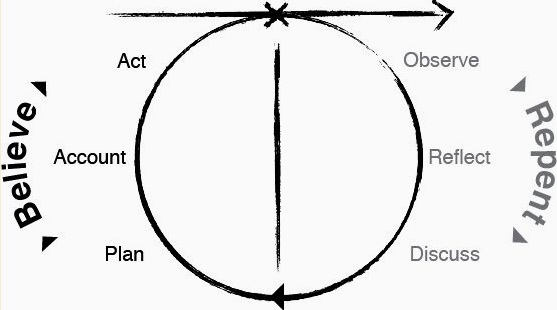
Have you ever witnessed a reaction when you use the word “repent”?  A powerful tool in the Mike Breen’s Life Shapes is the “Learning Circle.”  I was introduced to it about a year ago and have used it and taught it many times.  Like any tool, the more I use it, the more useful I find it.  I have found some folks react to it negatively when we get to a very important word, “repent.”  I’ve found a helpful way to work through that.
circle-kairos-learning-circle

Quick summary: It’s built from Mark 1:15 where Jesus says, “The  time (kairos) has come.  The Kingdom of God is near.  Repent and believe the good news of the Gospel.”  I love that.  Key words for the learning circle are kairos (the little x), repent, and believe.

A kairos is a God moment.  When you have an encounter with God, when “the Kingdom of God is near”, you can ignore it and keep going like nothing ever happened (take the straight line), or you can “repent” and “believe”,  take the circle.  Growth as a disciple is impossible unless we pay attention to those God moments (kairos), turn (repent) and apply (believe).

The word that some people get stuck on is “repent.”  But what does it mean to repent?  In my context – the Southern U.S. – many people can still remember preachers exhorting their listeners with the phrase, “Repent, you sinners.” I went to college at Auburn in Alabama. I still remember visiting preachers on the maul telling us what sinners we were and that we needed to repent – which seemed to mean a major rejection of everything we were doing in order to adopt a weird radical religious position.  I grew up southern Presbyterian.  Some people in the south came to Presbyterian churches, I think, to avoid preachers who used the word “repent” too much.  Those preachers tended to make everyone feel bad about everything that seemed fun and lively.

But to repent simply means to turn.  The Greek word is metanoia – it means to redirect or to “reorient” our lives toward God.  And that is not rejecting what is lively and fun.  Turning toward Jesus is an invitation to a life better than another – a life of purpose, community, joy, and life.  There’s plenty of laughter, good food, deep friendship, and celebration.  Of course there’s sacrifice and even suffering  – but with and for people you love.  (Sacrifice and suffering are realities for everyone in the world.  Reorienting ourselves to Jesus redeems hardship with purpose and hope.)

I find that if I only use the word repent – in my context, anyway – people dismiss the learning circle.  So, I use the word “reorient” a lot at first and explain that some people react to the word “repent.”   As I continue to teach, I use the word repent and reorient interchangeably, explaining as often as seems necessary to make sure there’s no misunderstanding.  That approach seems to work well to get past reaction to understanding.

Last thing, laughter helps – so here is a corny joke on the word “repent.”

A local church hired a painter to paint their steeple.  The paint had gotten dark and patchy.  So he climbed up on the steeple and went to work.  But he was a little short on paint, a little lazy, and a little dishonest.  To complete the job, he kept thinning the paint with paint thinner.  Just as he finished, lightning struck him.  He was thrown down from steeple.  But he was astonished to find that he was not harmed.  But the steeple, it was dark and patchy again, exactly like it was before he went to work.  Then he heard a voice from heaven say, “Repaint!  Repaint, and thin no more.”

Blessings.

Posted in Discipleship | Tagged , , , , , | Leave a comment

Get a Discipleship Mentor. Be a Discipleship Mentor.

Kind of a cool happenstance today.  I met with the Fellowship of Believers for a discipleship huddle.  (In discipleship huddles, we work on learning a set of tools for discipleship that we can use in our own lives and pass on to others.)  Well, we were meeting in a food court by Panera Bread when who should walk by but my mentor in this discipleship venture, Pastor Wayne Bauer.  

When I was learning about the 3dm discipleship tools, I figured out that I needed a mentor.  I needed an example to follow.  I needed someone who would invest in me so I could invest in others. And God led me to Wayne in a pretty astonishing way. (I’ll save that story for a blog post on answered prayers.)

Wayne was on his way to Nashville, TN with a group of youth from his church, Faith Community Church. I enjoyed introducing him to Andrew, Nap, Nicholl, Norma, and Tita.  What he’s been teaching me, I’ve been passing on to them.  He’d heard about them.  He’s prayed with me for them.  He has a connection to them because when I’ve had questions, problems, or challenges with discipleship, I’ve been able to turn to him for advice, prayer and encouragement.  In many respects, he has modeled for me what I am doing with them.

It was cool.  He walked up just as I was drawing out the Covenant Triangle, showing how it works with a the Learning Circle.  (These are two of the 3dm Life Shapes.  If you are a discipler, these are helpful tools.)   So I called out a hello to Wayne, held up the drawing, and said, “Hey, have you ever seen these before.”  We laughed.  I introduced the guy discipling me to the people I am discipling.  In one sense, he was being introduced to his “spiritual grand-children.”   His efforts have multiplied through me – and I am looking forward to the day when they multiply again.  

Do you know what happens if we keep this going?  Do you know what will happen if disciples keep making disciples?  The world becomes a different place on person at a time.  So thanks Wayne.  And I must say, I’m looking forward to seeing some “spiritual grand-children” of my own.


Posted in Uncategorized | Tagged , , , | Leave a comment

We are a Missional Church. What does that mean?

I did a google search last week for “missional church in Jacksonville.”   I got a few hits.  And I was a little disappointed.  What I found was that if a church had mission projects, they called themselves “missional.”  If they packed back-packs for kids, they call themselves “missional.”  I get it.  Missional is an adjective.  People want to communicate that their church actually does care about making the world a better place.  They want to communicate that they intend to bless the world.  That’s not a bad thing.  These churches are doing a lot of good.  But – and this is key – they are not doing anything that actually transforms the world.

You’ve heard the cliche, “Give me a fish and I eat for a day.  Teach me to fish and I will eat for a lifetime.”  What a lot of churches are calling “missional” resonates more with the first half.        

This morning, I talked with my church planting coach, Jessica Neely, about what it means to be missional.  She gave me two very helpful terms.  The first term is “missional gestures.”  These gestures can be small or they may be expensive, requiring heroic administrative efforts – but they are still gestures,  Here are a few examples that cover the range: stuffing backpacks for poor kids, raising money for the shelter, volunteering once a year at a food ministry, getting gifts for kids at Christmas, building a habitat house, going on a trip to a foreign country to do a construction project, etc.  If I participate in a missional gesture, I probably feel good about myself.  I have a hope that those benefiting feel good about what they receive.  But neither of us is transformed much. If I walked up to the person receiving the gesture and said, “I really care about you”, it would be disingenuous. Moreover, the missional gesture was a gesture.  It did not reflect the God who loves us so much that he entered into our mess in person, and revealed the fullness of grace and truth in Jesus.  And that is our calling.  

 The other term is “ministries of engagement”.  Just like it sounds, a ministry of engagement requires that we give ourselves in the effort.  It requires going to uncomfortable places, includes and element of sacrifice, and involves building relationships with people we don’t know,  It may involve risk, loss, and heartbreak.  And you’ll be changed.  You’ll probably find yourself blessed.  You’ll see the world differently.

I recall two examples of ministries of engagement.  One of the churches I served had a weekly food ministry.  They opened the doors of the fellowship hall twice a week at lunch time and fed anyone who wanted a meal.  The volunteers would prepare the meal, serve it, and then sit and visit with their “customers”.  The people involved began to change because they got to know, really know, the people who were in need.   The servers formed deep friendships.  They became a community.  They had war stories to share from the ministry.  Their faith grew as God answered prayers. They did Bible studies on their own and tried to apply what they were learning.  Spiritually, they asked me (their pastor) less self-centered questions and became more open and vulnerable in their prayers and prayer requests.  As for the customers, our church actually developed relationships with the people in our town who had needs.  A few of the “customers” even became members of the church.  Some saw their situation improve and got out of poverty.  Some didn’t change at all.  But I think our church came to understand better the God who is mindful of the least of these. 

Another example of ministries of engagement are the relational mission trips to partner with Vida Joven in Nicaragua.  We went back year after year to the same place to work along side the same people in Esteli, Nicaragua.  We built relationships. We learned stories.  We worked side-by-side.  We shared jokes.  We encouraged one another.  We prayed for one another.  We got to know their ministry and we wanted to find ways to serve.  Speaking for myself, I grew to know God better and to understand the Body of Christ better.  Ministry of engagement bears lasting fruit.

Two closing thoughts:

As we set up missional communities, I want to avoid the trap of becoming small groups that do missional gestures.  I’ve not been at this long, but I’ve already made the mistake.  Our mission activities – our “outs” – need to fall into the category of ministries of engagement.  Up until now, I’ve been using these four touch points: relational, sustainable, attractional, Christ-centered. I think I need to work on that list a bit.  Our outs need to lead us to a place of engaging the world.

Last thing, if you are a pastor of an established, traditional church, be careful if you sense the call to reform any culture of missional gestures in your church.  Those gestures often mean a great deal to the people in your church who pull them together. They may fear you are trying to take something away from them.  They may resent it if you refer to their activities as gestures.  They have probably poured time, energy, and money into the work.  And they may also resent celebrations of ministries of engagement.  So pray a lot.  

Blessings on the journey.


Posted in Uncategorized | Tagged , , , , | Leave a comment

MCE Lessons Learned

Good thoughts if you are considering launching a missional community or micro-church.

Pastor Jesse's avatarLearning and Launching a Missional Community

I find GK Chesterton’s words to be very encouraging: “Anything worth doing is worth doing badly.”  Discipleship usually begins with stumbling attempts.  But we want to get better.  That means, we need to learn from what we do.  Grace extends to us the freedom to try anything even if we fail at it.  But the wise person admits mistakes and learns from them.  Fools don’t and make the same mistakes over and over.

So here are some lessons learned from the Cimarrone MCE.   Hopefully we won’t repeat them – and maybe they can help you, if you are trying to launch a missional community. MCE stands for “Missional Community Experience”.  It was set up as a four month opportunity for people to experience doing church as a missional community.  We wrapped up two weeks ago.  I’ve debriefed formally and informally with a fair number of folks.  Some are continuing and others…

View original post 616 more words

Posted in Uncategorized | Leave a comment

Ready, Fire, Aim.

I heard something tonight at my daughter’s fifth grade graduation.  One of the speakers quoted a basketball coach who supposedly said, “Do what you need to do and do it right the first time.  Because you may never get the chance to do it over.”  

I appreciate the spirit.  We should all try to do things as well as we can.  But if I have to get it right the first time, I may never try to do anything worth doing.  Confession time: I learn best by missing the mark.  I learn the most from my failures.  I tend to get a little better with each attempt.  But if I had to get it right, I’d just melt under the pressure.

A few years ago, I heard Stan Ott say that in church work, the best approach is not, “Ready, Aim, Fire. HIt the mark”  but “Ready, Fire, Aim. Repeat.”  

I like that.  And those places where I’ve missed or messed up – those are the places where God’s grace is so abundant.  There’s fellowship there.  Freedom, too.  I fall down.  I get helped up.  We try again.  With missional communities, we learn all the time.  We have good guidance from 3dm and Verge network.  We have mentors and friends who help us.  But mostly, we learn by getting it wrong for a while and trying again.

G.K. Chesterton never coached basketball, but he once said, “If anything is worth doing, it’s worth doing badly.”  Amen.

Posted in Uncategorized | Tagged , , | Leave a comment